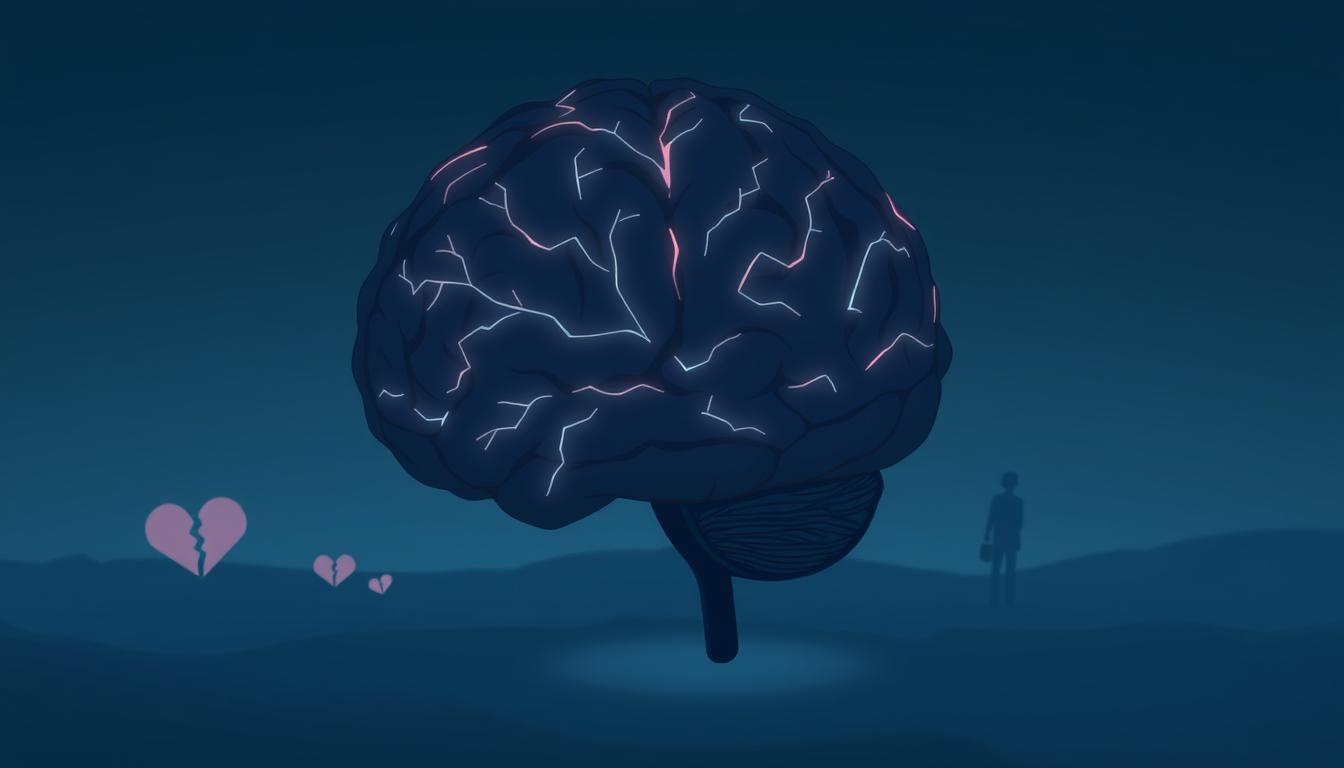
Feeling a deep longing after a relationship ends is common. Even if the relationship was unhealthy, our brains find it hard to move on. This is because our minds keep an emotional attachment bond with someone who’s gone.
Looking at it through Love Psychology, our brains want to be close to those we love. When we lose that closeness, our body feels like it’s withdrawing. This isn’t a sign of weakness but a natural response to losing someone important.
Understanding these feelings helps us see that they’re a normal part of the human experience. Recognizing this can help us deal with our grief better. It allows us to be kinder to ourselves as we go through this tough time.
Key Takeaways
- Missing an ex-partner is a natural biological response to broken attachment bonds.
- The brain often struggles to adjust to the sudden absence of a significant person.
- Longing for someone does not necessarily mean the relationship was healthy or worth saving.
- Love Psychology explains why the mind remains fixated on past connections during grief.
- Acknowledging these feelings as a standard process helps reduce unnecessary self-judgment.
The Biological and Evolutionary Roots of Love Psychology
The feeling of romantic attachment comes from deep in our biology. It makes us want to connect deeply with others. When a relationship ends, our brain has trouble adjusting to the loss.
This feeling of a partner is not just a memory. It’s a real physical state. The loss of this closeness is like a stress to our mind. This is why breakups hurt so much and are hard to get over.
The Role of Neurotransmitters in Romantic Attachment
Chemicals in our brain are key to bonding. When we’re with someone we love, our brain releases special hormones. These hormones make us feel good and safe.
Dopamine is what makes us feel good and motivated at the start of a relationship. Oxytocin and vasopressin help us trust and stay together long-term. When we lose a relationship, the drop in these chemicals can make us feel like we’re withdrawing.
| Neurotransmitter | Primary Function | Impact on Bonding |
|---|---|---|
| Dopamine | Reward and Motivation | Creates intense attraction |
| Oxytocin | Trust and Comfort | Promotes deep emotional intimacy |
| Vasopressin | Long-term Commitment | Supports pair-bonding stability |
Evolutionary Perspectives on Social Bonding
Humans are meant to live in groups. Having a romantic attachment helped us survive and protect each other. It made sure we stayed together to share and raise children.
So, when we lose a partner, our brain sees it as a big threat. The pain we feel is our brain’s way of trying to protect us. Even though our world has changed, these old instincts still guide us today.
Psychological Mechanisms Behind Post-Breakup Longing
Longing after a breakup is not just about the person. It’s about the emptiness left inside. When a relationship ends, the brain misses the good feelings it got from the partner. It tries to find a way to feel whole again.
The Impact of Interrupted Emotional Intimacy
Breaking up disrupts the connection we need for feeling stable. Without this bond, our brains try to fill the gap by thinking a lot. We often remember the good times and forget the bad.
This way of thinking can come from growing up in a critical or distant family. By remembering the partner in a perfect light, our minds try to ease the pain of losing them. This is a way to protect ourselves from the reality of the loss.
Attachment Theory and the Fear of Abandonment
Understanding love and attachment theory helps us see why some people feel worse after a breakup. These theories say our early life with caregivers shapes how we see safety in love. A deep fear of being left can come from these early years.
When a breakup happens, our way of thinking about love is shaken. This can make us feel like we’re in danger. Knowing this can help us see our recovery more clearly.
How Anxious Attachment Styles Influence Recovery
People with an anxious attachment style feel the worst after a breakup. They can’t stop thinking about the loss and want to get back together. This is their way of trying to calm their deep-seated fear of being left.
The Role of Avoidant Attachment in Processing Loss
On the other hand, those with an avoidant style might hide their feelings to feel independent. They might seem to move on fast, but they really struggle to deal with the loss. Their tendency to pull away can make it hard to fully process romantic attachment, leading to feelings that come back later.
| Attachment Style | Primary Reaction | Recovery Focus |
|---|---|---|
| Anxious | Hyper-vigilance | Self-soothing techniques |
| Avoidant | Emotional suppression | Acknowledging vulnerability |
| Secure | Balanced processing | Healthy grieving |
By understanding love and attachment theory, we can find out what triggers our feelings. Knowing our emotional intimacy needs helps us build stronger connections in the future.
Navigating the Healing Process
Healing from a lost connection is a journey that benefits from structured psychological tools. The pain of a breakup can feel overwhelming. But, by focusing on actionable strategies, individuals can regain their balance.
Building a foundation for future emotional intimacy requires patience and a commitment to personal growth. This is crucial for moving forward.
Applying Cognitive Behavioral Therapy for Love
Cognitive behavioral therapy for love is an effective method for managing post-breakup distress. It encourages individuals to trace their painful feelings back to specific thoughts. By identifying these negative patterns, one can gain the necessary emotional distance.
Challenging these thoughts helps reduce the intensity of longing. Instead of dwelling on the past, individuals learn to replace irrational beliefs with balanced perspectives. This process is essential for reclaiming personal agency and moving forward with a clearer mind.
Developing Emotional Intelligence in Love
Cultivating emotional intelligence in love allows people to understand their own needs and the needs of others more deeply. This skill set involves recognizing how past experiences shape current reactions. When someone develops high emotional intelligence, they become better equipped to handle future romantic challenges.
- Increased self-awareness regarding personal triggers.
- Better regulation of intense emotional responses.
- Improved ability to set healthy boundaries in new connections.
Understanding one’s own love languages also plays a vital role in this development. By knowing how one prefers to give and receive affection, individuals can foster more stable and fulfilling relationships in the future.
The Importance of Interpersonal Communication in Relationships
Effective interpersonal communication in relationships serves as the bedrock for long-term success. Even after a breakup, practicing these skills helps individuals articulate their needs clearly and listen with empathy. Many people find that professional relationship counseling provides a safe space to refine these communication techniques.
| Skill Area | Focus Point | Expected Outcome |
|---|---|---|
| Active Listening | Full attention | Reduced conflict |
| Boundary Setting | Personal limits | Increased self-respect |
| Conflict Resolution | Constructive dialogue | Stronger connections |
By prioritizing these communication habits, individuals can transform their approach to dating. This shift ensures that future interactions are built on a foundation of mutual respect and clear understanding. Ultimately, the goal is to build a more stable sense of self that remains intact regardless of relationship status.
Conclusion
Healing after a breakup means changing how you see things. Writing about your past helps you find closure and meaning. It turns hard memories into a guide for growing.
Getting help from a relationship counselor is very helpful. They give tools to move on. They help you see patterns that affect your feelings. This is a safe place to deal with grief and get stronger.
Knowing about love and attachment theory changes how you see past relationships. It explains why some bonds feel so strong and why breaking up hurts so much. This knowledge helps you make better choices in future relationships.
Learning about love languages makes you more aware of yourself and others. Knowing your needs helps you talk better with people. It gives you power in your healing journey.
The pain of loss is only temporary. With kindness to yourself and the right help, you can get through it. A brighter, empowered future is waiting for those who learn from their experiences.